
Industry Perspective
The Great Toilet Paper Debate Is Over
By Sergio Perez 2 min read
Some questions have challenged humanity for generations.
Which came first, the chicken or the egg?
Is a hot dog a sandwich?
And, perhaps most importantly, should toilet paper hang over the top of the roll—or underneath it?
Okay, maybe the last one has not received quite the same level of philosophical consideration. But in the facility-care industry, it has inspired more opinions than you might expect.
One of my longest-standing pet peeves has nothing to do with staffing, budgets, or service specifications. It is walking into a restroom and finding the toilet paper installed with the loose end hanging behind the roll.
I have always believed that the paper should come over the top. It looks cleaner, it is easier to reach, and aesthetically, it simply appears more intentional.
Whenever possible, that is how I have trained employees to install it.
For years, however, I had to accept that this was merely my preference.
Then I discovered the patent.
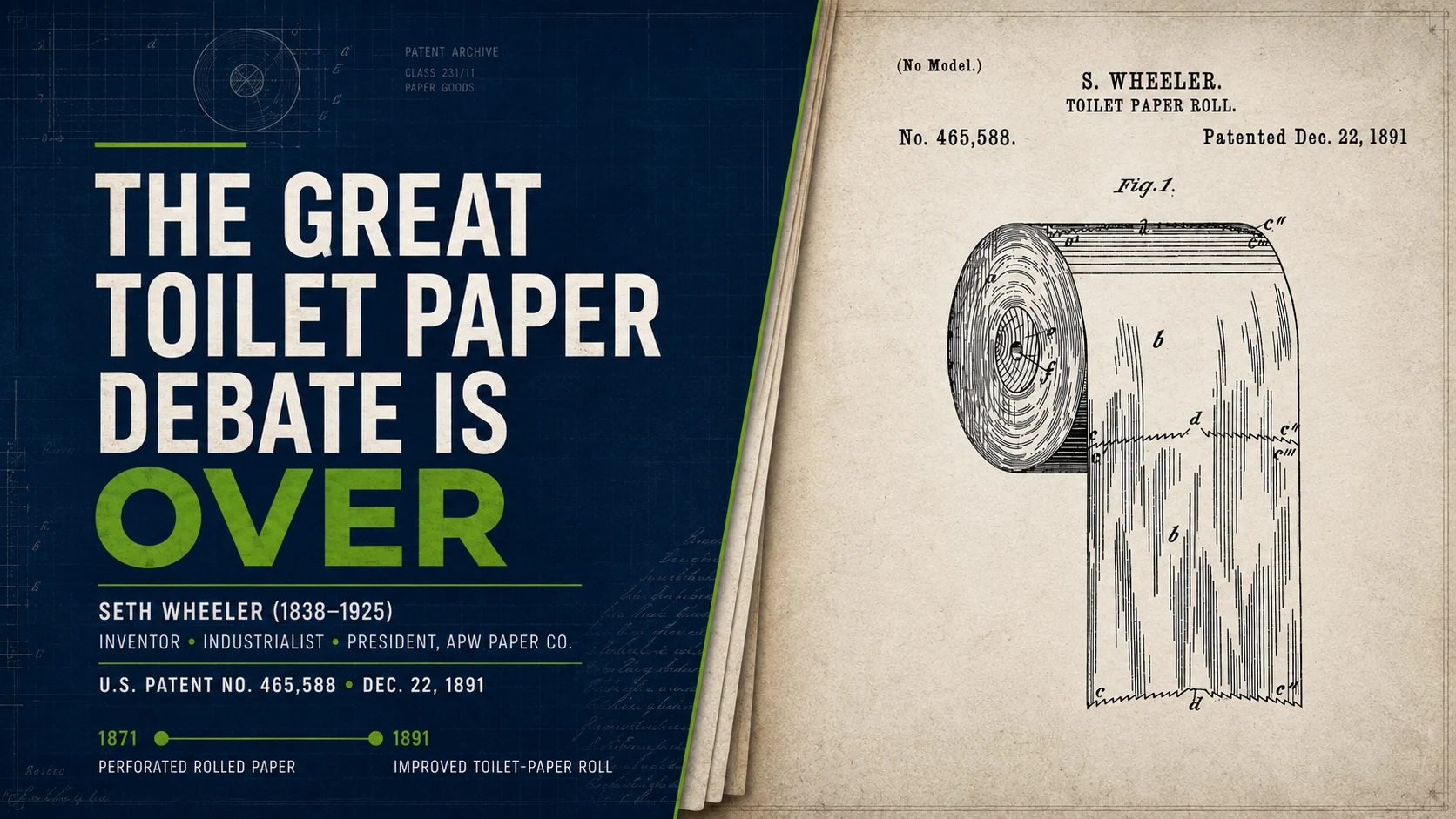
On December 22, 1891, Seth Wheeler of Albany, New York, received U.S. Patent No. 465,588 for an improved toilet-paper roll. The patent focused on the way the individual sheets were cut and connected so they could be separated more easily.
But take a close look at Figure 1 of the official patent drawing.
The paper hangs over the top.
Not underneath.
Over.
Now, to be completely accurate, the patent does not specifically declare that hanging the paper underneath is prohibited. There is no federal toilet-paper enforcement division—at least not that I am aware of.
Still, the inventor placed it over the top in the official drawing submitted with his patent. In the court of restroom opinion, I believe that qualifies as Exhibit A.
Hotels appear to agree. A properly prepared hotel restroom frequently has the paper hanging over the roll, sometimes finished with that familiar triangular fold. It is a very small detail, but it creates a clean, orderly, and completed appearance.
That is also what makes this amusing little debate relevant to facility care.
The details people rarely think about are often the same details that communicate whether a space has been properly serviced. A straightened chair, an aligned trash receptacle, a polished fixture—or even the direction of a toilet-paper roll—can subtly signal care and attention.
So, after more than a century of uncertainty, I am comfortable announcing that the matter has been settled.
The toilet paper goes over the top.
Those who prefer it underneath are, of course, free to continue doing so.
Just understand that the historical evidence is not on your side.
—Sergio Perez | Total Facility Solutions, Inc.